Yusleep ReviewHow to Stop Taking YuSleep Without Rebound Sleep Trouble: 6 Steps
How to Stop Taking YuSleep Without Rebound Sleep Trouble: 6 Steps
The short answer
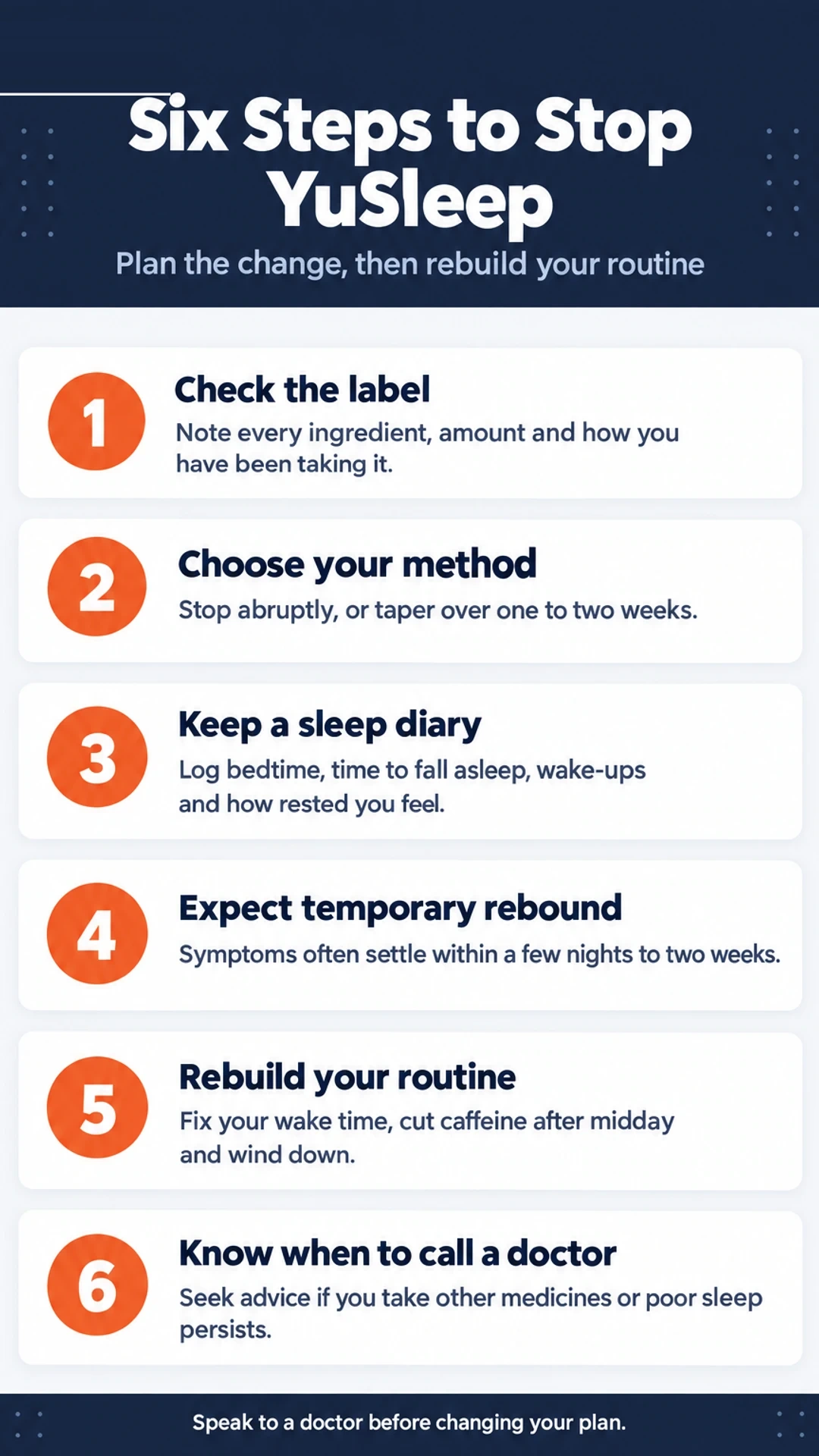
To stop YuSleep without rebound trouble, check the label ingredients, decide whether to stop abruptly or taper over one to two weeks, keep a simple sleep diary, and rebuild a consistent bedtime routine. Some people notice their usual sleep difficulties return for a few nights, which is usually temporary. Speak to a doctor first if you take other medicines, have anxiety or chronic insomnia, or if poor sleep persists.
Some links on this site are affiliate links: if you buy through one, the site may earn a commission at no extra cost to you. More about this.
By the end of this guide, you will know how to close out your YuSleep use on a schedule that suits you, with a plan for each night of the change rather than a vague sense that you should "cut back."
We have organised the steps in the order you would actually follow them, starting with what to read on the label and ending with how to know when your sleep has settled. Each step says what to do, what to watch for, and when it is worth calling a professional.
This guide is based on published specifications and what buyers report, not our own testing.
Once you finish, you will be able to choose between stopping outright and tapering, set up a sleep diary you can fill in within a few minutes a day, and build a wind-down routine that does not depend on any supplement. You will also know which warning signs mean it is time to stop waiting and speak to a doctor.
Step 1: Check what is in your YuSleep and how you have been taking it
Before you change anything, write down exactly what you have been taking. You cannot judge a stopping plan until you know which ingredients you are stopping and how much of each your body has been getting. Keep the bottle or packaging nearby, since you will need it for the next few steps.
Start with the label. List every active ingredient and its stated amount per serving. Ingredients often include melatonin, magnesium, L-theanine or GABA, but check your own product rather than relying on this list. Note the unit too (mg, mcg, or IU), because a number without a unit is easy to misread.
Then record how you have been using it:
- Servings per night: one, or more?
- Time of day: how long before bed do you take it?
- Duration: how many nights or weeks in a row?
- Form: capsule, tablet, powder or liquid?
Duration matters most. Someone who has taken a product for two weeks usually needs a different approach from someone who has taken it nightly for a year.
Next, check the vendor's own guidance on stopping. Look on the packaging, the product page or the insert for anything about discontinuation or tapering. Write down what it says and attribute it to YuSleep. Independent sources may give different advice, and the vendor's wording may not match what a pharmacist or doctor would recommend.
Finally, list anything else you take: other sleep aids, prescription or over-the-counter medicines, and caffeine (including tea, coffee and energy drinks, with rough daily amounts). These can change how stopping feels, so they belong on the same page.
Example: "YuSleep, one capsule at 9:30 pm, nightly for about six weeks. Label lists melatonin 1 mg and magnesium 100 mg. Also drink two cups of coffee before noon and take an antihistamine for allergies."
[screenshot: the supplement facts panel on the YuSleep label, with the ingredient amounts visible]
Step 2: Decide between stopping abruptly and tapering
Many sleep supplements can be stopped without a taper. If you took a product only now and then, or for a short stretch, you will probably notice little when you quit. People who have taken a supplement nightly for a long time often prefer a gradual reduction, because the body has adjusted to a routine and a slow step-down can make the change easier to manage. Neither approach is wrong. Pick the one that fits how long and how often you have been taking it.
Before you choose, check what you need:
- Your current serving size, from the label
- A calendar or notes app to track the reduced days
- A plan for what you will do if sleep problems return
If you choose a taper, use this simple method:
- Count your current nightly serving. Keep this number in mind as your starting point.
- For about one to two weeks, either take half the usual serving each night, or take the full serving every second night and skip the others.
- Log each night so you can see how your sleep changes.
- After the taper period, stop completely.
Some products come as a fixed capsule or tablet that cannot be split. In that case you cannot cut the dose, so skip nights on purpose instead. For example, if you take one capsule nightly, take one on Monday, skip Tuesday, take one on Wednesday, and so on, for one to two weeks.
[screenshot: a sample two-week calendar with taken and skipped nights marked]
This is general practice, not an instruction for this product. The label and a pharmacist are the final reference. Ask a pharmacist or your doctor before changing how you dose any supplement, especially if you take other medicines or have a medical condition.
Stopping approaches compared
| Approach | Best suited to | How it works |
|---|---|---|
| Stop abruptly | Occasional or short-term use | Stop taking the product |
| Taper | Long-term nightly use | Halve the dose or skip nights for one to two weeks |
Step 3: Set up a sleep diary before you stop
Before you reduce your dose, spend one to two weeks recording how you rest while still taking YuSleep as usual. Without that baseline, it is hard to tell a real rebound effect from ordinary variation from one night to the next. A diary gives you the comparison you need.
What you need: a notebook, a note app on your phone, or a printed log sheet. Use one format and keep it the same every day.
For each night, record:
- Bedtime (the time you got into bed, not the time you turned off the light)
- Estimated time to fall asleep, in minutes (a rough guess is fine)
- Number of times you woke up during the night
- Wake time
- How rested you feel on a 1 to 5 scale, where 1 is exhausted and 5 is fully refreshed
Add a short daily note on:
- Caffeine, including the time of your last cup of coffee, tea or soda
- Alcohol
- Screen use in the hour before bed
- Stress level or any notable worries
- Exercise, and when you did it
These factors often explain changes in rest better than the supplement does. For example, if you drank coffee at 4 p.m. on three nights out of seven and those nights show longer times to fall asleep, you have a clue that has nothing to do with YuSleep.
Keep the diary for at least one to two weeks before your first reduced dose. Then keep using the same format for the entire stopping period. Consistency is what makes patterns easy to spot. If you change the format halfway through, the two sets of notes will be hard to compare.
Step 4: Expect and manage possible rebound trouble
Stopping a sleep aid can bring back the problem it was meant to solve. Researchers call this rebound: the return, or temporary worsening, of the difficulty you were using the supplement for. For many people it settles within a few nights to a couple of weeks as your body adjusts. Knowing this in advance helps you avoid restarting the product out of habit before the rebound has had time to pass.
Buyers commonly report temporary changes in rest after stopping, but these reports are anecdotal. They are not a measured result, and this guide cannot tell you how often they happen with YuSleep specifically.
Before you reach for the bottle, try these non-supplement tools:
- Keep a fixed wake time. Get up at the same time every day, including weekends. This anchors your body clock more reliably than a late bedtime does.
- Stop caffeine after midday. Caffeine can stay active for hours, so an afternoon coffee may still affect your night even when you feel fine.
- Keep the bedroom cool and dark. Many people rest best in a cool room with blackout curtains or a sleep mask.
- Build a wind-down period. Spend 30 to 60 minutes on low-stimulation activities such as reading, a warm shower or gentle stretching, with screens off.
Track your rest for two weeks in a simple notebook: bedtime, time to fall asleep, wake-ups and how you feel in the morning. Patterns become much clearer on paper.
If you notice symptoms beyond poor rest, such as heart palpitations, confusion, severe anxiety or tremor, stop managing this on your own and contact a doctor promptly. These symptoms need medical advice, not a wait-and-see approach. If your trouble persists beyond a few weeks or affects your daily work, a healthcare professional can review your options and any underlying causes.
Step 5: Rebuild your bedtime routine over two to three weeks
Your rest will not settle the moment you stop the supplement. Your body needs a few weeks to learn a new pattern, and the habits below do most of the work. Start them during the first week you stop taking YuSleep, and give each one time before you judge it.
What you need: a consistent alarm, a lamp or dimmer switch, a book or a stretching mat, and a notebook or sleep app for your diary.
1. Pick one wake time and keep it seven days a week. Choose a time you can hold on weekends too. A fixed wake time anchors your body clock more reliably than a fixed bedtime, because the morning sets when your internal clock starts. Expect the first week to feel rough. Stick with it anyway.
2. Build a short wind-down routine. Aim for the same 20 to 30 minutes each night:
- Dim the lights about 30 minutes before bed.
- Read a physical book or do five to ten minutes of gentle stretching.
- Turn off work email at least 30 minutes before lights out.
Repeating the same sequence tells your brain that rest is coming.
3. Get daylight in the morning. Spend 10 to 15 minutes outside shortly after waking, ideally without sunglasses. Morning light helps set your body clock for the night ahead.
4. Use the 20-minute rule. If you are still awake after about 20 minutes in bed, get up. Sit somewhere dim and do something calm, like reading under a lamp, until you feel sleepy, then return to bed. Lying there watching the clock often keeps you alert.
5. Review your diary every week. Log bedtime, wake time, time to fall asleep, and how rested you felt. Compare each week's entries with the baseline you recorded before you stopped YuSleep. Look for a trend over two to three weeks, not a single bad night.
If your rest does not improve, or it worsens over several weeks, talk with a doctor or other health professional. Chronic insomnia has many causes, and stress, anxiety, caffeine, or a medical condition may be part of the picture.
Step 6: Know when to stop self-managing and see a professional
Stopping YuSleep on your own works for many people, but it does not always settle things. Some sleep problems come back, and a few situations call for a clinician's input rather than another round of trial and error. Knowing where that line is saves time and protects your sleep quality.
Before you stop, talk to a doctor or pharmacist first if you take prescription sleep medicines, antidepressants, or any other medications. Interactions and withdrawal effects can apply to those drugs, and a clinician can tell you whether and how to taper. Do not stop a prescription medicine suddenly just because you started a supplement.
After you stop, book an appointment if your sleep problems last longer than about two to three weeks, or if your daytime functioning drops. Watch for trouble concentrating, low mood, rising anxiety, or dozing off at work or while driving. Those signs mean you need proper support.
Bring the following to the appointment:
- Your sleep diary, with bedtimes, wake times, and night wakings for at least two weeks
- The YuSleep label, including the ingredients and dose you took
- A list of every other medicine, supplement, and caffeine source you use
Ask the clinician about evidence-based options for chronic insomnia. Cognitive behavioural therapy for insomnia (CBT-I) has more research support than most sleep supplements, and it addresses the habits that keep sleep problems going.
What to do now
1. Getting ready
- ☐ Write down exactly what you have been taking
- Note every active ingredient and its amount per serving from the label
- Record servings per night, timing, duration and form
- List other medicines, sleep aids and caffeine you use
- ☐ Choose to stop abruptly or taper
- Pick stopping outright if you took it only briefly or occasionally
- Pick a taper if you took it nightly for a long time
- Check the packaging for any vendor guidance on stopping
- ☐ Start a diary before reducing your dose
- Record bedtime, time to fall asleep, wake-ups and wake time each night
- Rate how rested you feel on a 1 to 5 scale
- Keep the same format for at least one to two weeks before the first reduced dose
2. Doing it
- ☐ Taper your dose over one to two weeks
- Take half the usual serving each night, or take the full serving every second night
- Log each night in your diary
- Stop completely after the taper period
- ☐ Manage possible rebound trouble
- Keep a fixed wake time every day
- Stop caffeine after midday
- Keep the bedroom cool and dark
- Spend 30 to 60 minutes winding down with screens off
3. Keeping it going
- ☐ Rebuild a consistent bedtime routine
- Keep one wake time seven days a week
- Dim the lights and read or stretch for 20 to 30 minutes before bed
- Spend 10 to 15 minutes outside in the morning light
- Get up if still awake after about 20 minutes, then return when sleepy
- ☐ Review your diary every week
- Compare each week's entries with your pre-stopping baseline
- Look for a trend over two to three weeks, not one bad night
Frequently asked questions
What are some self-care strategies for insomnia?
Keep a fixed wake-up time, even after a bad night. Get daylight within an hour of waking, avoid caffeine after early afternoon, and keep the bedroom cool, dark and quiet. If you are awake for more than about 20 minutes, get up, sit somewhere dim and return to bed only when sleepy.
What are the potential side effects of taking Natrol sleep'n Restore?
Natrol sleep'n Restore is a different product from YuSleep, so its label should be checked on its own. Commonly listed side effects of sleep supplements in general include morning grogginess, vivid dreams and headache. Read the label and ask a pharmacist if you have concerns, especially if you take other medications.
I can't sleep more than 4 hours. What could be causing this?
Waking after about four hours is often linked to an irregular schedule, caffeine or alcohol late in the day, or a bedroom that is too warm or bright. Stress and needing to urinate are also common causes. If it keeps happening for weeks, a doctor can check for sleep apnea, thyroid problems or other conditions.
What can I do to help with insomnia?
Start with habits you control: a consistent bedtime and wake time, no screens in the last hour before bed, and a short wind-down routine. Limit caffeine after noon and avoid heavy meals close to bedtime. If trouble persists beyond a few weeks, speak with a doctor rather than adding more supplements.
Conclusion
Stopping a sleep aid is easier when you change one thing at a time. Which step will you try first: tapering your dose, keeping a fixed wake time, or cutting late caffeine? Starting with the step you can control most easily tends to make the rest of the plan easier to follow. If symptoms are severe or last longer than a few weeks, talk with a doctor.