Yusleep ReviewIs YuSleep Addictive or Habit Forming? What the Evidence Shows
Is YuSleep Addictive or Habit Forming? What the Evidence Shows
The short answer
YuSleep is marketed by its vendor as non-habit-forming, and its listed ingredients are not controlled sedatives, so it does not carry the physical dependence risk of prescription sleep drugs. Any sleep product can still become a habit or a perceived need, usually through a bedtime routine rather than chemistry. Whether it is addictive depends on how it is used and on whether you feel unable to sleep without it.
Some links on this site are affiliate links: if you buy through one, the site may earn a commission at no extra cost to you. More about this.
If you are asking this question, you have probably noticed that you reach for a sleep product almost every night and wonder whether that is a problem. Maybe you worry that falling asleep without it has become harder, or that you cannot picture a bedtime without the ritual. That worry is reasonable, and it deserves a straight answer rather than reassurance from the packaging.
This guide is based on published specifications, the vendor's own claims (which we attribute to the vendor), and what buyers commonly report, not on our own testing. We separate two things that often get blended together: physical dependence, where your body adjusts to a drug, and habit formation, where a routine or expectation keeps you reaching for something. Here is what the article covers:
- Physical dependence: what the listed ingredients do and why they differ from controlled sleep medicines
- Habit formation: how a nightly routine can become a perceived need even with a non-drug product
- Warning signs: the patterns that suggest you feel unable to sleep without it
- Using it intentionally: how to set limits that keep the product a tool rather than a crutch
- Stopping cleanly: how to step back and what to check if sleep gets harder
Read on for a clear way to judge your own situation. For dosing and timing, see our guide on how to take YuSleep, and for long-term use questions, see our page on whether it is safe to take every night.
What "Addictive" and "Habit Forming" Actually Mean
Before asking whether YuSleep is addictive, it helps to be clear about what the word covers. People use "addictive" loosely, so the term can mean three quite different things.
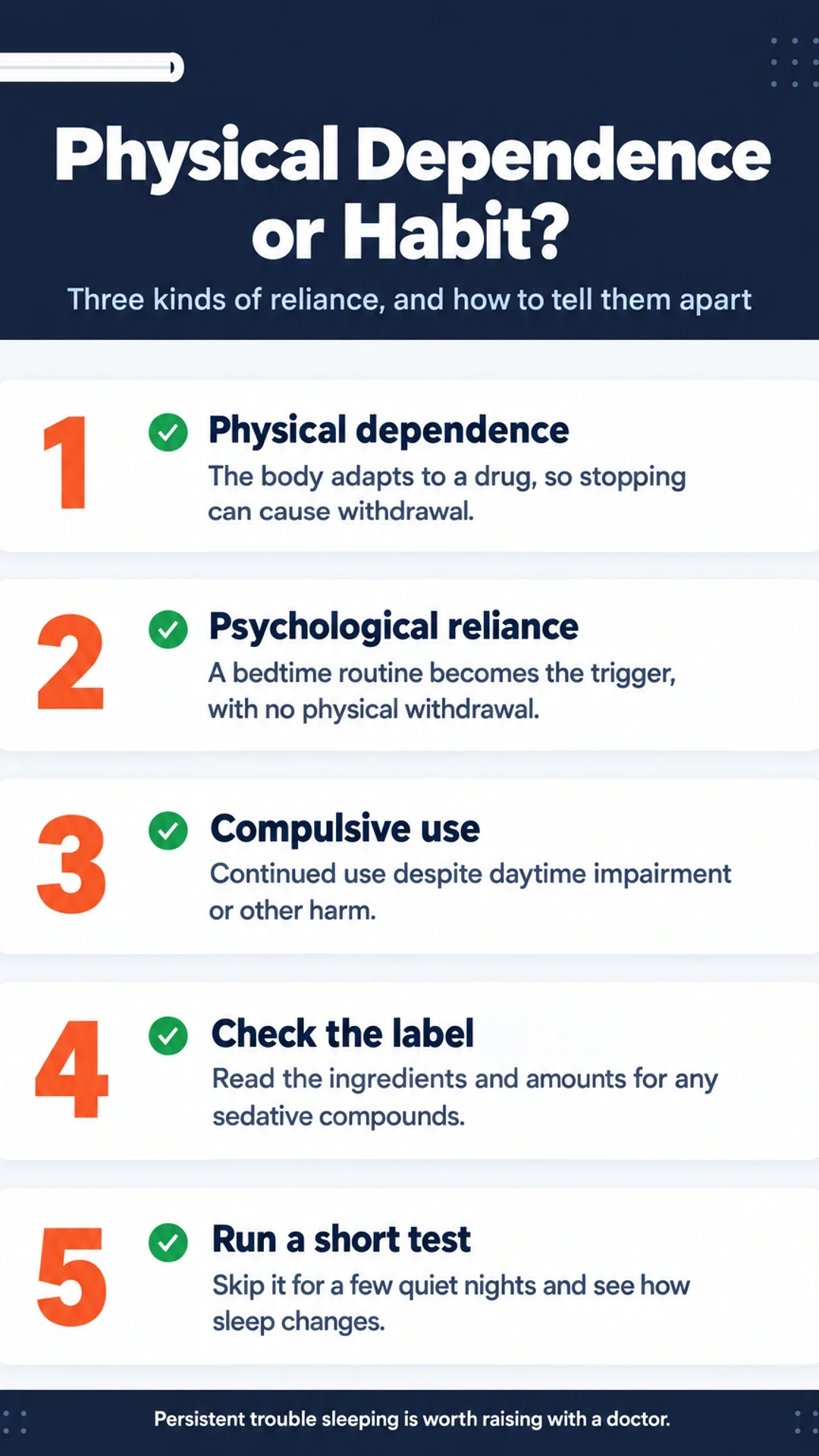
- Physical dependence. The body adapts to a substance so that stopping causes withdrawal. This is the pattern seen with some prescription sedatives, where the system adjusts to the drug and rebounds when it is removed. Physical dependence depends on a real pharmacological effect on the body.
- Psychological reliance. You feel you cannot fall asleep without a particular cue or ritual, even when the product itself has no physical effect. The routine becomes the trigger. This is a habit, and it can be strong, but it is not the same as the body needing a drug.
- Compulsive use. You keep taking something despite clear negative consequences, such as daytime impairment or harm to your health or relationships. This is the clinical sense of addiction, and it is the one that matters most when judging risk.
These overlap, but they are not interchangeable. A product can build a strong routine without any physical dependence, and a physically active drug does not always lead to compulsive use. Keeping the three apart makes the rest of the question easier to answer.
Three kinds of reliance compared
| Type | Cause | Physical effect |
|---|---|---|
| Physical dependence | Real drug effect on the body | Withdrawal on stopping |
| Psychological reliance | Routine or cue becomes the trigger | No physiological withdrawal |
| Compulsive use | Continued use despite harm | Not stated |
Can Sleep Itself Be Addictive?
Sleep is not addictive in the way that substances or compulsive behaviors are. It is a necessary physiological process that your body and brain need every day, and mainstream medical and scientific opinion treats it that way. You cannot become dependent on sleep the way you can on a drug, because sleep is not something you take in, and it is not a reward-driven habit you return to for a chemical effect.
When someone sleeps far more than usual, or feels constantly drowsy, it is usually a sign of something underneath. Common causes include:
- Depression, which often disturbs sleep and can cause either too little or too much of it
- Low thyroid function, which commonly causes fatigue and a need for extra rest
- Sleep disorders such as sleep apnea, which fragment the night so you wake unrefreshed
- Anemia, chronic stress or illness, and the effects of certain medicines
If you find yourself sleeping much more than normal, or feeling sleepy during the day most days, it is worth speaking with a doctor rather than assuming it is a habit to break.
Keep the question of dependence separate from sleep itself. Dependence applies to what you take. A sleep aid is a product, and whether it can cause dependence depends on what it contains and how you use it. Sleep is not a product, and the concern does not transfer to it. Looking at the substance, not the sleep, is the useful approach.
What the Ingredients and the Vendor's Claims Say
Whether a sleep supplement is habit forming depends mostly on what is in it. Start with the ingredient list and the published specifications on the YuSleep label, then compare each ingredient against what you already know about it. Most sleep supplements on the market contain melatonin or herbal extracts such as valerian, chamomile or passionflower. None of these are classed as controlled substances in the way that benzodiazepines or opioids are, so they do not carry the same dependence profile.
That said, "not a controlled substance" is not the same as "no risk." Some people who take a supplement every night for weeks start to feel they cannot fall asleep without it. That feeling is a psychological association with the bedtime routine, which is a different thing from physical dependence. Keep the two apart when you think about your own use.
YuSleep describes its product as non-habit-forming. That is the vendor's own statement. We have not found an independent study published by a third party that confirms it, so treat it as a marketing claim rather than a tested result. Ask the vendor for any clinical data behind the statement, and be cautious if none is offered.
It also helps to compare the product with prescription sedatives. Many prescription sleep medicines carry labelled warnings about dependence and withdrawal, and their prescribing information tells you not to stop abruptly after regular use. Check whether YuSleep's listed ingredients include any sedating drug class of that kind. If they are botanical extracts and melatonin only, its profile is closer to a supplement than a sedative, but the label remains the authority.
Practical checks before you buy:
- Read every ingredient and its listed amount, not just the headline claim.
- Look for any sedative or prescription-only compound, and note it if present.
- Use the lowest effective dose and avoid taking it nightly without a review point.
- Notice whether you feel you need it to sleep at all, especially if you have had stress or sleep issues for a long time.
What the label and the claims do and do not establish
| Point | Status |
|---|---|
| Non-habit-forming claim | Vendor's own statement |
| Independent third-party study | Not found by this article |
| Controlled sedative in listed ingredients | Check the label |
| Clinical data behind claim | Ask the vendor |
Habit Versus Dependence: How to Tell the Difference
Most people who take a sleep product every night are doing something that feels reassuring, and a routine is not the same as reliance. The useful question is whether the product is doing the work, or whether the ritual around it is. A simple way to find out is to run a short, low-stakes check on yourself.
Skip it for a few nights. Choose a stretch that is not stressful, such as a quiet week rather than a deadline or a trip. Keep your usual bedtime and wind-down, and note roughly how long it takes you to fall asleep. If sleep onset barely changes, the product was probably a comfort rather than a necessity. If you find it significantly harder to drop off, that is worth noticing, and worth discussing with a clinician rather than something to push through alone.
Separate the ritual from the product. Ask yourself what you actually miss. Is it the taste, the dim lamp, the same chair, the fixed sequence of brushing your teeth, dimming the lights and reading? If the routine is what you reach for, you can often keep it and change the contents.
Check whether something else is driving the problem. A product can mask issues that have not been addressed. Common ones include:
- Caffeine taken later in the day than you realise
- Screens in bed or close to lights-out
- Irregular wake times that shift your body clock
If any of these fit, fixing them tends to matter more than the product itself. Persistent trouble sleeping is also worth raising with a doctor, especially if it affects your day.
Signs of Problematic Reliance
Most people who take a sleep aid for a few weeks never feel any pull to keep using it. But dependence and habit formation are real concerns for some individuals, and it helps to know what to watch for. Many of the signs are about how you use the product, not just how often.
Taking more than the label describes
- You take it more often than the label allows, or you take a larger amount than recommended.
- You feel you need it every night for long stretches and cannot imagine falling asleep without it.
- You try to skip a night and find yourself lying awake, anxious, or unable to settle.
Using it for something other than sleep
- You rely on it to manage daytime alertness, mood, or stress, rather than to help you sleep at night.
- You feel uneasy or irritable when you cannot get it, and that feeling eases only when you take it again.
Sleep problems that persist
If your sleep stays poor despite regular use, a higher dose is usually not the answer. Persistent problems, especially trouble sleeping most nights for several weeks, are worth raising with a doctor. Ongoing sleep issues can have causes that a supplement will not address, and a doctor can help you look at them properly.
Using YuSleep Without Building Dependence
Whether a sleep aid becomes a habit depends less on the product itself and more on how you use it. The safest approach is to treat any sleep aid as a short-term tool with a clear end point, not a nightly routine you never question.
How do you set up a trial period?
Decide before you start how long you will use it, such as two to four weeks, and put a date on your calendar. At that point, review honestly: are you sleeping better, and do you still need it? If the answer is no, that is your cue to stop rather than drift on.
What should you do with the label?
Follow the label's directions on dose and timing, and do not exceed them on nights when sleep is especially poor. Taking more does not reliably produce better sleep, and it makes it harder to tell whether the product is helping at all.
What habits do the work regardless of the product?
Most of the benefit for sleep quality usually comes from habits that stand on their own:
- Keep a consistent wake time, even on weekends. This is often the single most useful anchor for your body clock.
- Dim lights and reduce screen brightness in the hour before bed.
- Keep the bedroom cool, dark and quiet.
- Get daylight in the morning, which helps set your day and night rhythm.
If these are in place, you rely on the product less, and that matters most for people whose sleep issues are tied to stress or a busy day.
How do you stop if you want to?
Where practical, reduce gradually rather than stopping abruptly. Expect a few nights of ordinary adjustment as your sleep settles back to its own pattern. That is normal and usually passes. For more detail on avoiding a rough patch, see our guide on stopping without rebound trouble sleeping.
Frequently asked questions
What are some self-care strategies for insomnia?
Keep a fixed wake-up time every day, even after a bad night, and get morning daylight. Avoid caffeine after early afternoon, keep the bedroom cool and dark, and stop screens or work about an hour before bed. If you are still awake after roughly 20 minutes, get up, sit somewhere dim, and return when sleepy.
What are the recommended sleep recommendations for different age groups?
The National Sleep Foundation's commonly cited ranges are about 14 to 17 hours a day for newborns, 11 to 14 for infants, 10 to 13 for toddlers, 9 to 11 for school-age children, 8 to 10 for teenagers, and 7 to 9 for adults. Individual needs vary, and a supplement label does not replace these general ranges.
What to do after sleeping all day?
Get up at your usual time if you can, and expose yourself to bright light soon after rising. Eat a normal meal, move your body for a few minutes, and avoid napping again before evening. If this pattern keeps happening, especially with low mood or lost daily function, a doctor can help look for the cause.
Why do I need 10 hours of sleep?
Needing around 10 hours is unusual for most adults and is often linked to a recent illness, a sleep debt built up over several nights, or conditions such as depression or sleep apnea. If you regularly need that much and still feel unrested, it is worth discussing with a healthcare professional rather than assuming it is normal.