Yusleep ReviewIs YuSleep Safe in Pregnancy or While Breastfeeding? What the Label Does and Does Not Say
Is YuSleep Safe in Pregnancy or While Breastfeeding? What the Label Does and Does Not Say
The short answer
The YuSleep label and vendor materials tell pregnant or breastfeeding people to speak with a healthcare professional before use. They do not, based on the published wording reviewed here, state that the product is safe for either situation. Because it is a dietary supplement, it is not assessed for pregnancy or breastfeeding safety the way a prescription drug is. A clinician who knows your full medical history can give a specific answer.
Some links on this site are affiliate links: if you buy through one, the site may earn a commission at no extra cost to you. More about this.
- What the label actually says: the exact wording on the packaging and vendor pages, and how it differs from a clear safety statement.
- Why supplements are treated differently: what rules apply to dietary products and why that matters for pregnancy questions.
- Questions to bring to your clinician: the specific ingredient details to check and how to phrase them.
- Warning signs that mean stop and call someone: symptoms that call for prompt medical advice rather than waiting.
- How to evaluate other sleep options: safer conversations to have if you find YuSleep isn't a good fit.
If you are pregnant, breastfeeding, or trying to conceive, sleep problems can feel urgent and a little lonely, because the usual advice seems to vanish once a pregnancy starts. You want to rest without guessing about your baby. That worry is reasonable, and this guide takes it seriously.
We promise a clearer picture of what the published materials say, what they leave out, and how to get a real answer. This guide is based on published specifications and what buyers report, not our own testing. We explain how we chose the products we discuss, then walk through the label language line by line, so you can tell exactly where the uncertainty lies before you decide.
What the YuSleep Label and Vendor Materials Actually Say
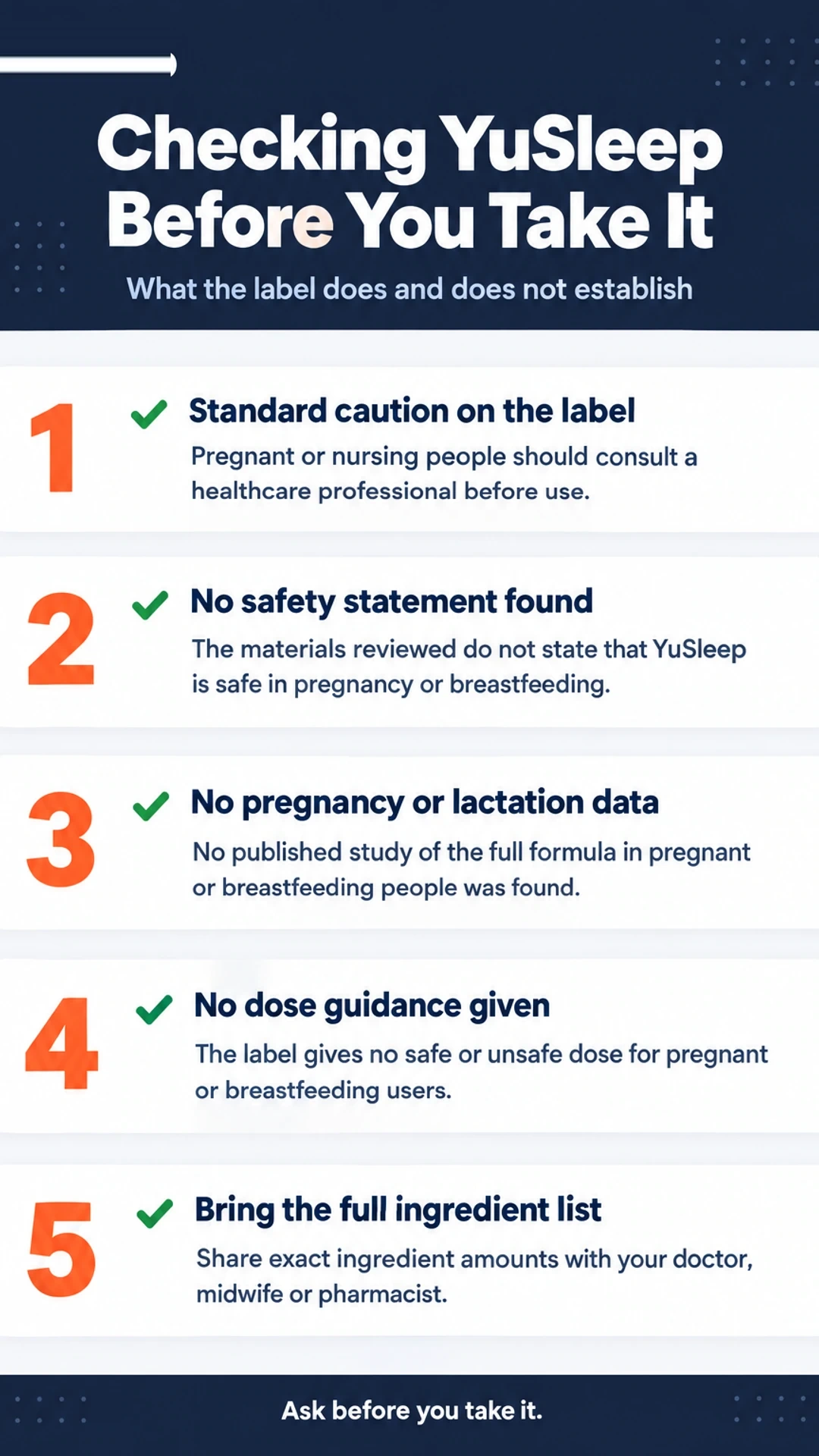
If you are pregnant or breastfeeding, the most useful first step is to read exactly what the official materials say, not what you assume they say. We reviewed the YuSleep vendor site and the product listings we could access at retailers, and the wording on pregnancy and nursing is consistent across them. It reads, in substance: pregnant or nursing people should consult a qualified healthcare professional before use.
That sentence is standard supplement wording. It is not a specific finding about YuSleep in pregnancy, and it does not say the product has been studied in pregnant or breastfeeding people. It is the kind of caution many supplement makers attach to products as a general precaution.
What we did not find is a dedicated pregnancy or breastfeeding safety section on the vendor pages we reviewed. There is no data on use in these groups, and no explanation of why the product is or is not considered suitable. Put plainly, the materials we checked do not answer the question with evidence.
Check these points yourself before deciding:
- Read the physical label or the current packaging, since wording can change between batches and versions.
- Look for the pregnancy or nursing line, and note whether it is a general caution or a specific statement.
- Compare the ingredient list with what your clinician has already told you about your medicines and supplements.
- Ask a qualified healthcare professional, such as your obstetrician, midwife, or pharmacist, whether it fits your situation.
If the label and the vendor pages disagree, or the wording is unclear, treat that as a reason to ask your clinician rather than to decide on your own.
What the Label Does Not Say
If you are pregnant or breastfeeding, you need to know what is actually established about YuSleep and what is not. The short answer is that we could not find a published pregnancy or lactation study for the full YuSleep formula in the sources we reviewed. That is a gap, not a green light.
The label itself does not give a safe or unsafe dose for pregnant or breastfeeding people. It does not say the product has been checked for use during pregnancy, and it does not describe what happens to a baby who receives the ingredients through breast milk. If you are looking for a clear yes or no on the packaging, you will not find one.
Marketing language can make this harder to see. Words like "natural" and references to clinical support sound reassuring, but they do not answer the questions that matter here. A plant-based ingredient can still have effects on a developing baby or on milk supply, and a clinical claim about adult sleep says nothing about pregnancy or infant exposure.
Keep these points in mind:
- No pregnancy or lactation data for the full formula turned up in our review.
- The label gives no dose guidance for pregnant or breastfeeding users.
- "Natural" and clinical-support claims do not address pregnancy or infant exposure.
- Missing warnings are not the same as evidence of safety.
The practical step is to ask your doctor, midwife or pharmacist before you take YuSleep, and to bring the full ingredient list with you. They can weigh the individual ingredients, including melatonin, against your situation and your baby's needs.
What the YuSleep label does and does not establish
| Point | Status in the article |
|---|---|
| Pregnancy or lactation study for full formula | Not found in sources reviewed |
| Dose guidance for pregnant or breastfeeding users | Not given on label |
| Dedicated pregnancy or breastfeeding safety section | Not found on vendor pages |
| Standard advice to consult a healthcare professional | Stated on label and vendor materials |
| Natural or clinical-support claims | Do not address pregnancy or infant exposure |
Why Supplements Get Different Scrutiny in Pregnancy and Breastfeeding
If you are pregnant or breastfeeding, it is reasonable to ask why a product that is sold freely still deserves a careful look. The answer comes down to how supplements are regulated. In many markets, dietary supplements do not have to go through the same pregnancy safety testing that a medicine would. A drug maker typically has to show how a compound behaves in the body, including whether it crosses the placenta. A supplement maker usually does not. That means the absence of a warning on a label is not the same as evidence that a product has been shown to be safe in pregnancy.
Many active compounds can cross the placenta or pass into breast milk, which is why clinicians ask about every ingredient rather than only the headline one. This is a general pattern across substances, not a finding about any specific product, so the practical step is to look at the full ingredient list and bring it to your clinician.
Why would a clinician treat sleep problems differently in pregnancy?
Trouble sleeping in pregnancy often has ordinary causes: back or hip discomfort, heartburn and reflux, and getting up repeatedly to urinate. Each of these can be addressed in its own way, such as changing position, adjusting meal timing or managing fluids in the evening. So a clinician may approach a night of poor sleep as a problem to unpick rather than something to solve with one product.
What changes when you are breastfeeding?
Breastfeeding adds a second person to consider. Your infant's exposure to anything you take depends on what reaches your milk, and a baby's ability to process a compound can differ greatly from an adult's. Two people's needs now sit in the same decision, which is one reason to check before you buy rather than after.
Questions to Ask Your Doctor, Midwife or Pharmacist Before Using It
If you are pregnant or breastfeeding, the label is only the starting point. It tells you what is in the product, but it cannot tell you how those ingredients fit with your own body, your history or the other things you take. So it helps to arrive at the appointment with specific questions.
Start with the package itself. Bring the full ingredient list and the stated amount of each ingredient per serving, copied exactly as printed, not from memory or a website summary. Clinicians can only judge what they can see, and a vague description ("contains a sleep blend") is not enough for them to work with.
Does any ingredient have a known concern in pregnancy or breastfeeding?
Ask directly whether any listed ingredient has a known concern in pregnancy or while breastfeeding, and whether there are safer options for your situation. Melatonin, for example, is one ingredient that is often discussed with a clinician in this context, and the right answer depends on your stage and circumstances. Ask whether a different approach would make more sense for you.
What else are you already taking?
Make a complete list of your other medicines, prescription or not, and all supplements, vitamins and herbal products. Include any magnesium, since many people take it already. Also be honest about alcohol use, because the label and most guides advise against combining it with sleep aids. Your pharmacist can check the combinations quickly.
What can help with sleep in the meantime?
Ask what you should do about sleep now, not just whether to take the product. Many clinicians recommend non-drug measures first, such as keeping a steady time to fall asleep and wake up, limiting screens before bed, and using a calm wind-down routine. If stress or anxiety is keeping you awake, mention it, because treating that can improve sleep quality more than any single product.
What to Do If You Already Took It Before Knowing You Were Pregnant
Finding out you are pregnant after you have already taken a sleep supplement is a common and understandable situation. It is worth acting on, but it does not call for panic. Start with the practical steps below.
- Stop taking the product now. If you are still using it, stop, and do not take any more doses.
- Contact your doctor, midwife or pharmacist promptly. Tell them the product name, read out the ingredient list from the label, and give a rough estimate of how many doses you took and over what period.
- Keep the packaging. The exact formula matters for the conversation, so hold on to the box or bottle, and photograph the label if it is easier.
Can I just look up the risk online?
We would advise against relying on internet guesses. Online forums and general articles rarely account for your individual situation, the exact dose, how far along you are, or your health history. A clinician can weigh those specifics and decide whether any monitoring is needed. Many people in this position are reassured after that conversation, but the decision belongs with your care provider, not with a search result.
If you have been taking the product to help you fall asleep or manage stress and anxiety, mention that too. Your clinician may want to talk through safer ways to get good sleep quality during pregnancy, and that conversation is a better starting point than trying to work it out alone at night.
Non-Drug Sleep Options Clinicians Commonly Discuss
If you are pregnant or breastfeeding, the question of whether a sleep product is safe is worth taking to your midwife, obstetrician or pharmacist before you start anything. Many of the people who ask about a supplement are really asking how to sleep better, and there are steps that do not depend on a product at all. These are the approaches clinicians most often raise.
What can I do with my routine to help my body settle?
Keeping a consistent sleep and wake time, even on days that feel unpredictable, gives your body clearer signals about when to wind down. Getting outdoor light in the morning, if you can, helps set your internal clock so that you feel more ready for sleep when night comes. This does not need to be a long walk. Ten to fifteen minutes outside with your face toward the light is a reasonable start.
How do I stop caffeine and fluids from keeping me up?
Caffeine stays in the body for hours, so an afternoon coffee can still affect how easily you fall asleep at night. Many people find it helps to have their last caffeinated drink before early afternoon. If reflux or night-time trips to the bathroom are disrupting your sleep, try drinking most of your fluids earlier in the day and sipping less in the last hour before bed.
Which sleeping positions do guides usually suggest?
Many prenatal and postnatal guides suggest sleeping on your side, often with a pillow between your knees and another supporting your bump or back. Small adjustments in position can make a real difference to comfort and to how often you wake, and they cost nothing to try.
When should I speak to a clinician about my sleep?
Some sleep problems need assessment rather than a product. Talk to your clinician if you have persistent insomnia, if your mood changes in a way that worries you, or if you notice breathing pauses, loud snoring or gasping during sleep. These symptoms deserve a proper look, and your clinician can help you find the right next step.
Non-drug sleep measures discussed by clinicians
| Measure | Typical practical detail | Main purpose |
|---|---|---|
| Consistent sleep and wake time | Same times, including unpredictable days | Clearer signals for winding down |
| Morning outdoor light | Ten to fifteen minutes outside | Sets internal clock |
| Earlier caffeine cutoff | Last drink before early afternoon | Reduces caffeine still active at night |
| Earlier fluid intake | Most fluids earlier, less in final hour | Fewer night-time bathroom trips |
| Side sleeping with pillows | Pillow between knees, another for bump or back | Comfort and fewer wake-ups |
Frequently asked questions
Is YuSleep safe to take during pregnancy?
The product label does not establish that YuSleep is safe in pregnancy, and it should be treated as not proven safe. Pregnant people should not start any sleep supplement without first asking their doctor, midwife or pharmacist, who can check the actual ingredients and doses against their own situation.
Can I take YuSleep while breastfeeding?
Nothing on the label we reviewed confirms that YuSleep is safe while breastfeeding, because the packaging does not address milk transfer or infant effects. Ingredients can pass into breast milk, so check with your doctor, pharmacist or lactation consultant before using it.
What does the YuSleep label actually say about pregnancy and breastfeeding?
Based on the publicly available product information, the label does not give a clear pregnancy or breastfeeding statement either way. Silence on the label is not the same as a safety finding, so look for explicit wording from the manufacturer and confirm it with a clinician.
Why do pregnancy and breastfeeding need extra caution with sleep supplements?
Many sleep aids contain ingredients that have not been studied in pregnant people or in infants who receive breast milk, and small studies or limited data are often all that exists. Because the baby is also exposed, many clinicians advise avoiding unnecessary supplements unless a doctor has weighed the benefits and risks.
What should I do before deciding whether to use YuSleep during pregnancy or breastfeeding?
Bring the full ingredient list and dose per serving to your doctor, midwife or pharmacist, and ask specifically about pregnancy and breastfeeding. Also ask about safer first steps for sleep, such as regular bedtimes and reducing evening light and caffeine, which clinicians often suggest first.
Wrapping up
The YuSleep label does not clearly establish safety in pregnancy or while breastfeeding. That silence is a reason to ask a clinician first, not a green light. Check the ingredient list and dose with your doctor, midwife or pharmacist before you start. Have you asked a clinician about a sleep aid during pregnancy or breastfeeding? Tell us what they said in the comments.