Yusleep ReviewIs YuSleep Safe to Take Every Night? What the Label Says About Long-Term Use
Is YuSleep Safe to Take Every Night? What the Label Says About Long-Term Use
The short answer
YuSleep is generally regarded as acceptable for short-term use, but the label does not establish that nightly use over months is safe. Its main active ingredient, melatonin, has limited long-term safety data for nightly supplemental use. Vitamin B6 is within normal limits at typical doses, though total intake should be tracked over time. Anyone with an ongoing health condition or who takes other medicines should check with a doctor or pharmacist before nightly use.
Some links on this site are affiliate links: if you buy through one, the site may earn a commission at no extra cost to you. More about this.
- The short-term picture: what the label supports and where its claims stop
- Melatonin and long-term use: why nightly supplemental use is less studied than occasional use
- Vitamin B6 totals: how to add up intake from other foods and supplements
- Who should pause and ask first: the situations where a professional should weigh in
- What the label leaves out: the questions the packaging does not answer
If you are thinking about taking YuSleep every night, you are probably hoping for a sleep aid you can rely on without worrying about what it does to you over time. That is a fair thing to want, and it is harder to answer than it looks. Nightly supplements are often marketed as if a short trial and a permanent routine carry the same risk. They do not.
This guide is based on published specifications and what buyers report, not our own testing. Our aim is to separate what the label supports from what it leaves open, so you can make a decision you can defend. We will walk through the melatonin question, the vitamin B6 question, the groups who should check first, and the gaps on the packaging itself. Along the way we point you to our other pages on dosing, ingredients and side effects, where those topics get the full treatment.
Short Answer: Is YuSleep Safe for Nightly Use?
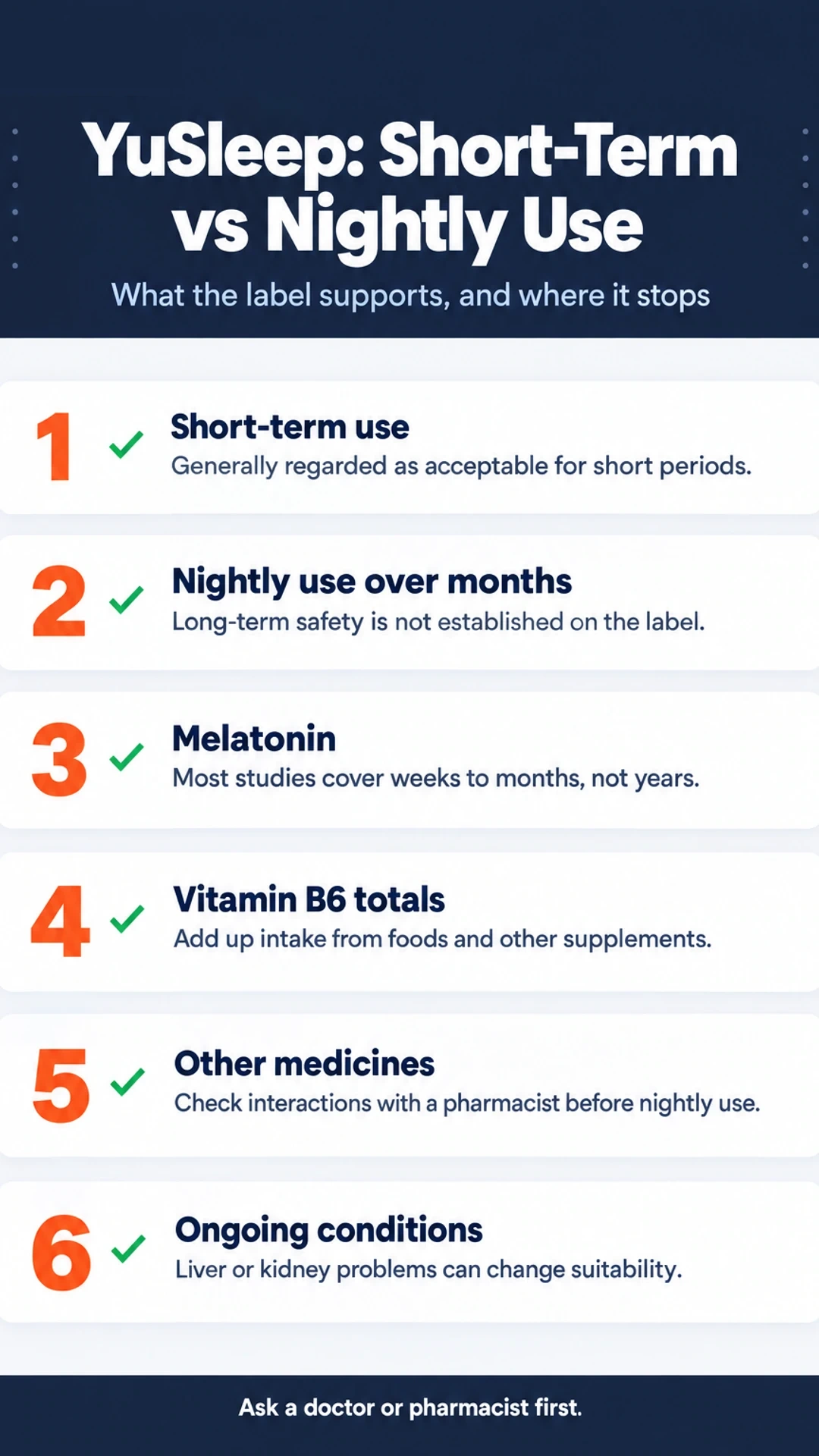
Short answer: many sources consider sleep supplements like YuSleep acceptable for short-term use. The mild effects people most often report include morning grogginess, vivid dreams, or stomach upset. Nightly use over long periods is a different question, and the evidence there is thinner, so the honest answer is less certain. Whether a nightly routine is a reasonable choice for you depends on a few things:
- Your health status. Existing conditions, especially liver or kidney problems, can change how a product suits you.
- Your age. Sleep needs and the way the body handles ingredients both shift over the years.
- Other medicines. Interactions with prescriptions or other supplements are the most common reason for concern.
- How long you keep going. A few weeks is a different situation from months of daily use.
We based this section on published label information and general guidance on sleep aids, not on any clinical trial of YuSleep itself. Ingredients such as melatonin and magnesium have been studied in various settings, but a product's long-term safety record depends on how it is formulated and dosed. That detail is worth checking on the label.
If you plan to take it most nights, talk with a doctor or pharmacist first, and read the label's own guidance on duration. If you notice persistent trouble falling asleep, anxiety, or no improvement in sleep quality, that is a reason to get a professional assessment rather than simply continuing the supplement.
Short-term versus nightly use
| Use pattern | What the article says | Main caution |
|---|---|---|
| Short-term use | Generally regarded as acceptable | Mild side effects such as grogginess |
| Nightly use over months | Evidence is thinner and less certain | Long-term safety not established on label |
| Ongoing health condition | Ask a doctor or pharmacist first | Liver or kidney problems can change suitability |
| Other medicines | Interactions are the most common concern | Check with a pharmacist before nightly use |
What the YuSleep Label Says About Long-Term Use
We cannot see the YuSleep label itself from here, and no label text was supplied for this page, so this section describes what to check on the actual packaging rather than quoting it. Read the label before you decide anything about nightly use.
Start with the parts that carry the most weight:
- Duration guidance. Look for any statement about how many nights in a row the product is meant to be used, or whether it is intended for occasional use.
- Warnings. Note any caution about drowsiness, driving, alcohol, or combining it with other products.
- Who should not take it. Labels usually name specific groups. Check for mentions of medical conditions, pregnancy, or medications.
Website copy and customer reviews often describe a product as suitable for every night. That is marketing language, not label language, and it may go further than the label does. Treat the label as the reference point, and treat other claims as the vendor's or buyer's own view.
Also watch for silence. If the label gives no long-term data, that does not show the product is safe for nightly use over months or years. It means the manufacturer has not published that evidence on the label. Ask the vendor directly, and talk to a doctor or pharmacist about whether nightly use suits your situation, especially if you have chronic sleep problems, anxiety, or take other medications.
The Ingredients and Their Long-Term Considerations
Most questions about nightly use come down to the ingredients, so it helps to look at each one separately.
Melatonin is the ingredient with the most questions. Most research on melatonin supplements covers short periods, often a few weeks to a few months. Multi-year nightly data is much thinner, so it is hard to say with confidence what happens after years of daily use. Common short-term effects reported in studies include:
- Drowsiness, especially if you wake up before the effect has worn off
- Headache
- Dizziness
- Nausea
If you notice these regularly, that is a reason to talk with a doctor rather than simply taking more.
Vitamin B6 is generally tolerable at typical amounts. The concern is cumulative intake. If you take a multivitamin, eat fortified cereals, and use a supplement like this one, the amounts can add up over weeks and months. Checking the total from all sources is the simplest way to stay within reasonable limits.
Other calming ingredients vary a lot in how well they have been studied. For each one on the label, check whether there is solid human research behind it and whether it interacts with medications you already take. Your pharmacist can help with the interaction check, and it is worth a quick look before a nightly habit sets in.
Common melatonin effects and what to do
| Effect | Reported in studies | Suggested action |
|---|---|---|
| Drowsiness | Yes, especially on waking early | Talk with a doctor if it recurs |
| Headache | Yes | Talk with a doctor if it recurs |
| Dizziness | Yes | Talk with a doctor if it recurs |
| Nausea | Yes | Talk with a doctor if it recurs |
Long-Term Melatonin Use: What the Evidence Does and Does Not Show
Most of the clinical research on melatonin covers periods of a few weeks to a few months. That is useful, but it means the evidence on taking it every night for years is thinner. If you plan to use a melatonin product long term, you are working with a shorter research record than the marketing might suggest.
Part of the reason is how melatonin is classified. In some countries it is sold as a dietary supplement, which generally means less pre-market review and less routine oversight of what is actually in the bottle. In others it is regulated as a medicine, with stricter rules on labeling and quality. Check which framework applies where you live, because it shapes how much you can rely on the label.
Will I need it less over time?
Some people find their sleep improves and they can cut back or stop. Others feel they cannot fall asleep without it. Neither outcome is guaranteed, so it is worth tracking your own pattern:
- Note how many nights a week you use it and how long it takes you to fall asleep.
- Record how you feel on waking, and whether you still need it for the same reasons as before.
- Review this every few weeks, and bring the pattern to a doctor or pharmacist if you are unsure.
Persistent sleep problems or chronic insomnia deserve a professional assessment rather than indefinite self-treatment.
A Checklist: Is Nightly Use Right for Your Situation?
The label is the starting point, but the label alone cannot tell you whether nightly use suits you. Work through the points below and be honest about your answers. If several apply, talk to a pharmacist or doctor before making a nightly habit of it.
Do any of these factors raise caution?
- You are pregnant or breastfeeding.
- You are giving it to a child or teenager.
- You have a seizure disorder.
- You have an autoimmune condition.
- You have liver or kidney disease.
- You take sedative medicines or blood-thinning medicines.
Any of these is a reason to ask a professional before nightly use, not a reason to panic. People in these groups often can use sleep aids safely, but the decision belongs with a medical professional who knows your history.
What signs mean you should stop and seek advice?
- You feel drowsy the next day in a way that affects driving or work.
- Your sleep gets worse rather than better, or your sleep problems return stronger.
- You notice new mood changes, including low mood or increased anxiety.
- You develop an allergic reaction such as rash, swelling or breathing difficulty. Seek urgent help for breathing problems.
What should you ask a pharmacist or doctor before nightly use?
- Is nightly use appropriate for my health, and how does it interact with my current medications?
- What is the maximum dose, and does it differ for my situation?
- Should I set a review date to reassess whether I still need it?
- What should I do if I want to stop?
Setting a review date is a practical habit. It keeps nightly use from becoming automatic when your sleep may have improved.
When to Review Nightly Use with a Clinician
Most sleep products are labeled for short-term or as-needed use, and the label is the best starting point for judging whether nightly use still fits. If you have been taking YuSleep every night past the period the label or your doctor suggested, schedule a review. Keep track of how many nights you have taken it and whether you still feel you need it, so you have clear details to bring to the appointment.
Why does poor sleep keep coming back?
A supplement can help you feel more relaxed at bedtime, but it does not treat every reason people struggle to sleep. Chronic stress, anxiety, shift work, pain, a shifted schedule, late caffeine, or another medical condition can all cause sleep problems that a product will not fix. If you still wake up unrefreshed after weeks of use, the underlying cause deserves attention. A clinician can help you look at that cause and consider whether other approaches or medications are more appropriate.
What should you ask before you stop?
If you have taken a product nightly for a long time and want to stop, ask about tapering rather than quitting abruptly. Some people notice rebound trouble sleeping when they stop suddenly, and a gradual reduction, planned with a professional, can make the transition easier. Bring the product name, your usual timing, and how long you have been using it.
- Note the date you started nightly use.
- Write down any side effects or changes you have noticed.
- List other sleep aids, medicines, or supplements you take.
- Ask whether a follow-up check is needed after stopping.
Frequently asked questions
Is it okay to take Natrol melatonin every night?
For many healthy adults, nightly melatonin is generally considered low risk for short periods, and many people use it for weeks or months. The label is the best starting point: it lists the dose, the age range, and any cautions. If you need it most nights for longer than a few weeks, check with a doctor or pharmacist before continuing.
What is the safest sleep aid to use?
No sleep aid is risk-free for everyone, so the safest option depends on your health, age, and what else you take. Good sleep habits, such as a steady wake time and limiting screens before bed, carry the least risk. For products, choose one with a clear label, a dose that matches the instructions, and no conflicts with your medicines.
What is the best vitamin for good sleep?
No vitamin has strong, consistent evidence as a general sleep aid for people who already get enough of it. Vitamin D and magnesium are sometimes linked to sleep, mainly when a deficiency exists. If sleep problems are ongoing, a blood test and a conversation with a clinician can show whether a supplement is actually needed.
What happens if you take 3 sleep gummies instead of 2?
Taking a third gummy raises your total intake of each ingredient, which can increase the chance of morning grogginess, vivid dreams, or stomach upset. Going above the label's serving size is not a good idea, even if the product seems mild. Stick to the labeled amount, and if one dose is not enough, talk to a doctor rather than adding more.
Can you take sleep gummies every night for months?
The label usually states a daily serving and warnings for use, but it rarely tells you how safe long-term nightly use is for everyone. Many people take them regularly without problems, yet this is different from proof of long-term safety. If you plan to use them for months, review the label, watch for side effects, and check with a healthcare provider.
Wrapping up
Nightly use of YuSleep is a question the label answers only in part. Follow the serving size and age guidance printed on the package. If you plan to take it most nights for weeks or longer, check with a doctor or pharmacist first, especially if you take other medicines.
What has your experience been with nightly sleep products? Share your questions in the comments.